
Hermitage of Madonna degli Ulivi | CASTELLO
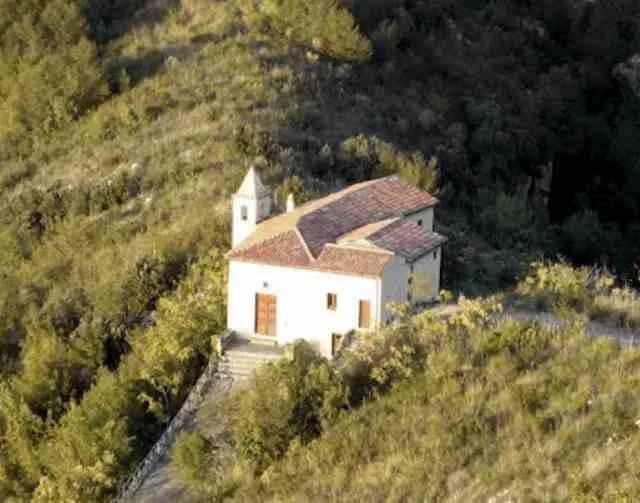
The small Hermitage of Our Lady of the Olives (or of the Snow) is located behind the Basilica of St. Blaise, near the parking lot for visiting Maratea Castello.
This hermitage is one of the testimonies of the paleo-Christian era in Maratea, a historical period during which the city was frequented, like the entire South, by the phenomenon of Byzantine monasticism, often improperly referred to as "Basilian".
Works of art in the Church
The little church had been long abandoned and, after falling into ruins, the restoration of the interior has preserved some fine frescoes from the 14th to the 15th century that decorated the single nave, including a Saint Catherine of Alexandria on the left of the apse, above which one sees an afezoro Christ Pantocrator in clear Byzantine style.
On the opposite side, a well-preserved Madonna with Child can be seen.
The church owes its double dedication to the main altar, carved from a single olive root, and to the polychrome wooden statue of the Madonna of Snow with Child, which was once celebrated by the inhabitants of Maratea on August 5th each year.
Visit the Madonna of the Olive Tree
Leave the car in the Madonna degli Ulivi parking lot (enter Madonna della Neve parking lot or degli ulivi in your navigator) and continue on foot.
Eremo of Our Lady of Olives
(or Church of Our Lady of Snow or of Help)
Pills of history
An altar made from an olive root and a feast celebrated on August 5 explain the two names by which this small place of worship in Maratea is known: Our Lady of Olives and Our Lady of Snow. The first is traditionally linked to the wood used for the altar; the second refers to the summer Marian feast day.
The hermitage occupies a secluded position behind the San Biagio Basilica, in the space between the peak of the mountain and the rock of Suda. Adjacent to the rectangular church with a single nave are spaces dedicated to living quarters and the storage of provisions: areas that allowed living next to the place of prayer. The presence of ancient roads in the vicinity has also suggested a possible use as a reception point for religious and travelers, without this function being confirmed.
To reconstruct its past, it is necessary to distinguish between hypotheses and archival testimonies. The link with the Byzantine monasticism is commonly proposed to explain its origins, but there is no certain date of foundation. Among the documents identified by the local scholar Luca Luongo, a visit by the bishop in 1601 mentions the church with a name that is little known today: Santa Maria la Laudabile. More explicit about its use as a hermitage is the Catasto of 1753, which records the expenses for the maintenance and clothing of a hermit.
The life of seclusion at the place was interrupted by the events of 1806. According to Luongo, during the French siege of Maratesta, the Franciscan Francesco Maimone, who was living in the hermitage, was killed for refusing to collaborate with the attackers. In the following decades, the building went through alternating phases of decline and restoration. The restoration completed in 1994 allowed its reopening for worship on the very day of the August 5, the Feast of the Madonna of Snow.
The church is also a stop on the Cammino di San Biagio (Saint Blaise’s Way), a walking route linking places of worship with stretches through nature. From Maratea’s historic centre, the route leads to the Capuchin chapels and the Church of Sant’Antonio, then continues towards the Madonna degli Ulivi and the Basilica of San Biagio before descending past the Church of San Vito to the Mother Church.
To organize a visit inside the hermitage, it is advisable to contact the parish and check the openings. The path presents an easy to moderate difficulty: for information about the route and to undertake it with a guide, you can contact local tour operators.