
Lucani in the world | people of Lucania
Leonardo Sinisgalli
PEOPLE OF LUCANIA
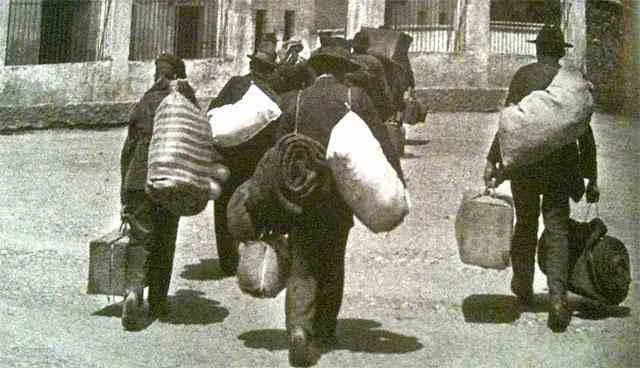
Many Lucans travel around the world, but no one sees them; they are not exhibitionists.
The Lucan, more than any other people, lives well in the shadows.
Wherever they go, they make their nest, without disturbing the neighborhood with threats or the "mumciupì" with their demands.
They are few of words.
[continues: Lucans in the world | people from Lucania | Leonardo Sinisgalli ]]
When he walks he prefers to take off his shoes, go barefoot.
When he works he does not speak, he does not sing.
No one can understand where he found such patience, such endurance.
Accustomed to being content with the bare minimum, he will always be amazed by his neighbors' joy, his friends' exuberance, and the excitement of those around him.
You are born a Lucanian and you remain one.
The emigrants who return from Colombia or Brazil, from Argentina or Australia, from Venezuela or the United States, after forty years of absence, never tell anything about the life they have led as exiles.
They return to the circle of the rural day, to shantytowns or caves, content to chew on a fennel stalk or a lettuce leaf, to watch a pot boil, to listen to the fire crackle.
And to go out at dawn if they have work or a service to perform, to go out in the dark to return at night.
It is not a vocation for conspiracy or robbery but an instinctive wariness of the sun. Where there is too much light, the nocturnal creature hides, where there is too much noise, the nocturnal creature withdraws. One does not have time to understand this animal, to take a step together, before it flees at the turn. To go where?
Friends who are familiar with the Lucani understand the strategy; they cook them in their own soup. There is a characteristic trait of the Lucani that has eluded travelers, from Norman Douglas to Carlo Levi, benefactors, from Adriano Olivetti to Clara Luce, and perhaps even sociologists.
The lucanian never consoles himself for what he has done, it is never enough for him what he does.
The lucanian is haunted by the demon of dissatisfaction.
Speak to a farmer, to a shepherd, to a vintner, to an artisan.
Talk to him about his work.
He will answer that he had something else in mind, something different.
He will do it again.
[continues: Lucani in the world | people of Lucania | Leonardo Sinisgalli ]
Like the Hindus, like the Etruscans, he too believes that perfection is not of this world.
And indeed, schoolboys and boatmen, stonecutters and tailors, masons and potters are buried with all their tools still in their possession.
They think they can complete the Work in another life.
When they will have peace.
In their own land, they cannot find the conditions they need to do what they do best.
A strange ethic.
The final touch, the touch of grace, will forever elude the Lucanian.
Yet in the clarity of the design, you may glimpse the finished work.
Only a breath is missing.
These are a people whom wisdom has brought to the threshold of folly.
Like a hen that balks at a line drawn in chalk, the Lucanians’ intelligence is distracted by the slightest thing, brought to a standstill by the mere sound of a fly.
(From L. SINISGALLI, The Portrait of Scipio and Other Stories, MI, Mondadori, pp. 165-166)
Lucani in the world | people of Lucania | Leonardo Sinisgalli
The website www.maratea.info is updated by the volunteers of ALTRITURISMI.it
MAKE A DONATION
- To stay updated on the activities of AltriTurismi ETS -> Subscribe to the newsletter