
Madonna of Piety
The small hermitage of Madonna della Pietà is located on the ridge of Mount S. Biagio overlooking the Filocaio neighborhood, where it stands out for its milky white color.
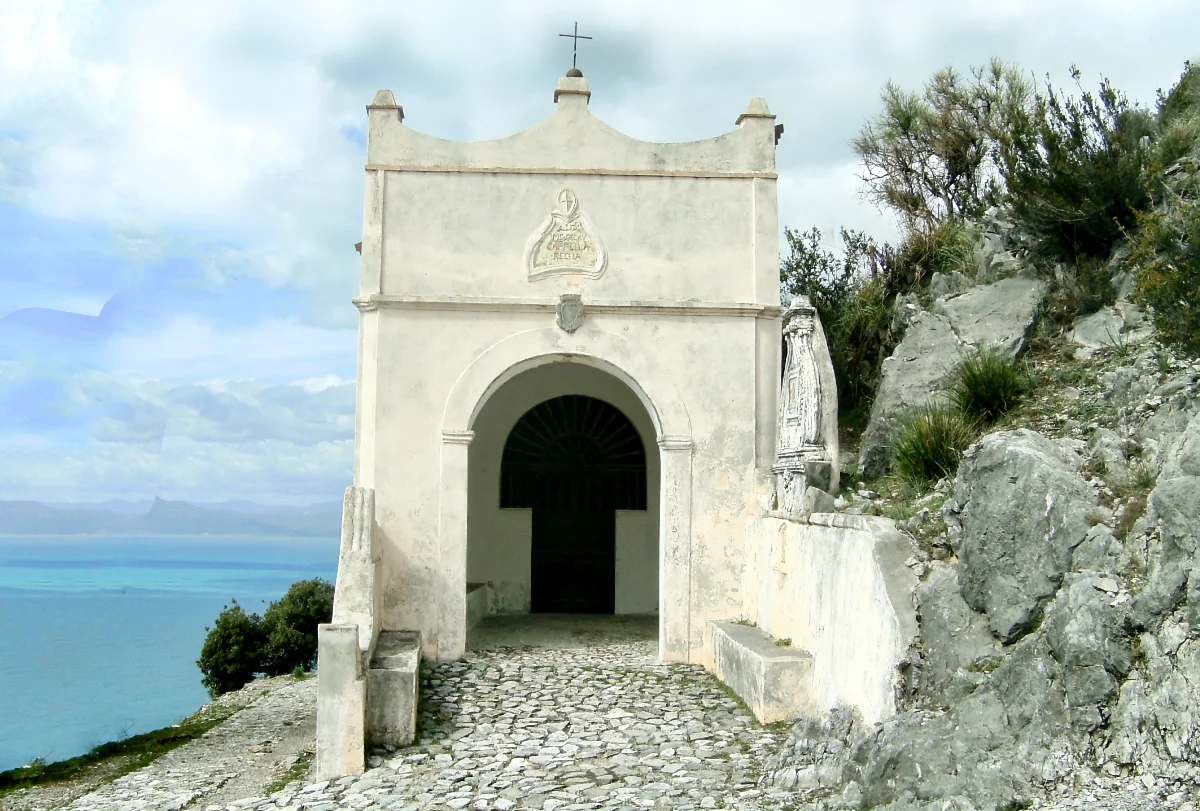
Works of art in the Church
Another emblem of the Byzantine ascetic monasticism
has been restored in 1808 in poor Baroque style. Inside one finds a bas-relief of the Pietà from 1810.
Visit the Eremo of Madonna della Pietà
The path to reach the hermitage, from the turns that lead to the Castello di Maratea, has a medium level of difficulty.
Nevertheless, it is recommended to visit it only with a local guide.
Maratea
Madonna della Pietà Hermitage
Historical notes and visit tips
The ancient paths of Maratea connected the coast to the higher settlements and offered, along the way, small places to stop and pray. This network includes the Church of the Madonna della Pietà, a white-walled building that rises above Filocaio, on the slopes of Mount San Biagio.
Also known as a hermitage, the church is associated with the presence of monks of Byzantine tradition, but the numerous modifications to the building do not allow for a definitive determination of its founding date. The south-facing portico could have accommodated the religious during their movements between monasteries: an interpretation consistent with the complex’s location, though lacking definitive confirmation.
To describe a more recognizable phase of its history are the dates preserved in the furnishings and decorations. The font basin dates to 1808, an external inscription to 1809, while the crowned coat of arms above the entrance and the sculpture of the Pietà bear the date 1810. A painted ceramic, inserted in the niche next to the entrance, instead bears the date 1814. These elements testify to the interventions that, at the beginning of the nineteenth century, contributed to defining the appearance of the church.
The chronology of the works shows some differences in the available reconstructions. The Parishes of Maratea indicate an expansion and restoration in 1810, attributed to Blasius Gennaro Satriani; the scholar Luca Luongo notes a refurbishment in 1828, promoted by the priest Biagio Ginnari Satriani. It is therefore more prudent to attribute the renovation of the building to the early decades of the nineteenth century, without grouping all interventions under a single date.
Inside, baroque stucco work accompanies the intimate space of the single nave. The image of the Madonna of Piety appears both in the marble sculpture placed above the altar and in the tempera painting that decorates its front. The two works are attributed to southern artists whose names are unknown. On the right is the font, described in sources as made of chalcedony and enclosed in a stucco frame.
The hermitage is one of the stages of the Hermitage Trail, along with the St. Paul’s Chapel. The trail follows an ancient mule track that connected the coast facing the island of Santo Janni with the upper part of the Maratea valley, restoring the link between these places of devotion and the surrounding landscape.
Those wishing to follow the trail should consider the presence of sun-exposed sections and wear appropriate footwear. Any potential visit inside the church must be organized by first checking the availability of opening hours.