
The medieval village of MARATEA
Alleys and alleys ...
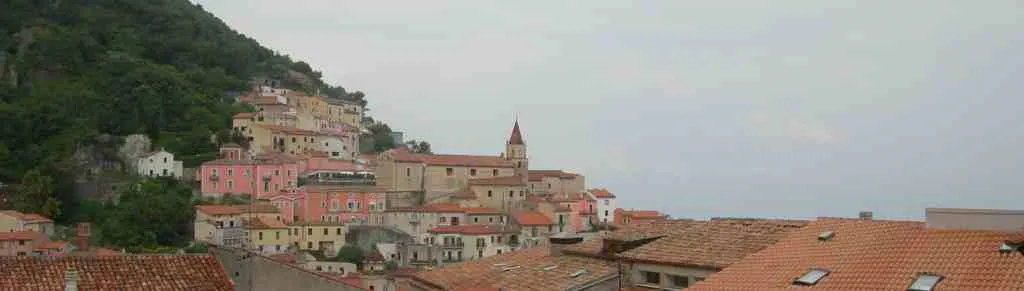
The "BORGO" or the Historic Center of Maratea has the characteristic medieval structure, with old houses decorated with loggia and doorways, stacked together and divided by narrow alleys and angulations.
From Piazza Buraglia, turning into Via Cavour, one reaches the obelisk of the Addolorata (1788), a work of an unknown Lucanian sculptor commissioned by citizen Gerardo Laurelli, behind which is the church of the Addolorata, dating from 1620.
Italy's last travel frontier
A NEW WAY TO EXPLORE THE CITY
AN ENTRING TREASURE HUNT
that unites the entire family in fun
MARATELL. THE LEGACY OF THE SARACEN
A StreetAdventures™ necklace adventure
"the Borgo": Historic center of Maratea
The website www.maratea.info is updated by the volunteers of
- To stay updated on the activities of AltriTurismi ETS ->
On Via Pietra del Pesce, one passes by the seventeenth-century Palazzo Picone, former town hall, and by crossing Largo Palazzo with a small central fountain, one arrives at the belvedere of Pietra del Sole, from which one can enjoy a magnificent view of the entire valley and coast.
From Palazzo Street, along Via Gafaro, one arrives at the rock upon which stands the Lieto Palace, built at the beginning of the 18th century to house the first hospital of Maratea in 1734; just a few meters away, the piazza of Santa Maria Maggiore opens up with its main church, and immediately to the right, the eighteenth-century palace of Orlando.
The church of S. Maria Maggiore was erected between the 13th and 14th centuries, and has undergone numerous subsequent expansion interventions.
The square base of the bell tower dates back to 1434, while the second octagonal order is from the seventeenth century; in the seventeenth century, the portal was executed and the former defensive tower was incorporated.
The website www.maratea.info is updated by the volunteers of
- To stay updated on the activities of AltriTurismi ETS ->
The original core of the Village
On the facade facing the little square, there are two marble low reliefs dating from around the middle of the 15th century.
Inside are various works of art of some value, including a wooden choir stalls with inlaid work from the 1400s and a statue depicting Madonna degli Angeli from the 1600s. [explore]
Starting from the piazza of S. Maria Maggiore, one accesses the oldest part of the settlement through a staircase that leads to Santicelli Street and from there to Capocasale Street, which then continues all the way to the Castle.
In this oldest part of the town, the 17th-century Casa Calderano is worth seeing for its fine doorway. From here, a narrow lane climbs to Maratea’s oldest church, the Church of San Vito, built alongside the town’s first houses between the 11th and 12th centuries.
It features notable frescoes from the 1300s, including a Madonna with Child, and from the 1500s, depicting the figures of St. Roch and St. Blaise.
On the side of the church rises a beautiful bell tower, the result of a nineteenth-century reconstruction.
continues at: PIAZZA BURAGLIA ->