Fauna and flora of the Maratea Coast
The plant and animal populations of the coast of Maratea
The spontaneous flora of the Maratea coast is typically Mediterranean scrub; the fauna of the rocky shore is varied and consists of crabs, anemones, mussels, limpets, and finally sea urchins.
The Palinuri Petagna primrose is the most important endemic species on the coast of Maratea, and together with the so-called Santo Janni Dragon, the peregrine falcon, and the thermomediterranean shrublands, they represent the most important elements of the ecosystem to be protected.
Petagna's Primula Palinuri

The Primula palinuri Petagna (named after the Italian botanist, physician, and entomologist Vincenzo Petagna - Naples, 1730/1810) is the only variety of Primula found in Southern Italy and is found only near the coast, within a maximum distance of three to four hundred meters from the sea.
Bloom occurs between February and March, when other local species are still dormant, with beautiful and truly unique semi-pendent white/yellow flowers, clustered in umbels.
The plant reaches a maximum height of 12 cm with a maximum diameter of 25 cm, featuring leaves with dentated edges and an egg-shaped profile, arranged in rosettes.
The Primula Palinuri Petagna is found in rare locations along the stretch of coast that starts at Cape Palinuro and extends throughout the Gulf of Policastro.
Flora
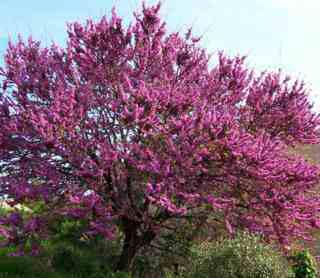
The spontaneous flora of Marateo's coast is typically the Mediterranean scrub, consisting mainly of Phillyrea, Olive Myrtle, Cistus, Myrtle, Strawberry Tree, Hop Tree, and Oleander also known as the Tree of Judas. Among the other plants of the scrub stands out the Ampelodesmus mauritanicus in the local language "tagliamani", used for the realization of "libani" or "libbani", vegetable ropes for fishing and for various other uses.
The slopes are characterized by the ruins of terraced plots marked by dry stone walls, which host carob trees, fig trees, olive trees, vines, pine trees, and the ever-present wild fennel.
In the wall cavities, we find rare miniature specimens of Aleppo pines, while prickly pears grow spontaneously and are also used to mark cultivated plots, as are agaves and bougainvillea.
Behind the coastline, we find ancient junipers, pink thrift flowers, yellow-orange poppies, and tree spurge. In the central part of the coastal strip, the rare dwarf palm (known as Saint Peter's Palm) blooms spontaneously.
the Fauna
The fauna present is typical of the rocky marine coast, and specifically includes the herring gull, the peregrine falcon, the pale swallow, and finally the blue-breasted solitary sparrow.
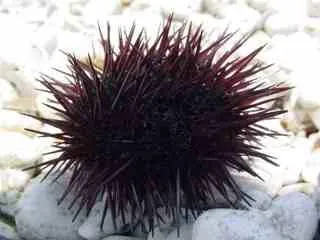
The fauna of the rocky shore is varied and consists of crabs, anemones, mussels, limpets, and finally sea urchins; in deeper waters on the low seabed, starfish and red sea tomatoes are common, and further out, gorgonians.
marine backgrounds
The seabed is rocky to a depth of about 35-40 meters, after which it becomes clay-silt type; below such depths, the environment is typical of the poseidonion and precoralligene.
In particular, in the area of Marina and Punta Caina, there are beautiful prairies of Poseidonia oceanica, while in the Ogliastro area, one can appreciate the delicate orange flowers of the sea mat Astroides calycularis.
The deep depths are instead the realm of groupers, dentex, salema, bream, sea breams, and rarer species such as the John Dory, Painted Comber, Scabbardfish, Sea Fans, Mirabilis, Hermit Crab, Mediterranean Cushion Star, the orange one, and the common sea turtle (the famous Caretta caretta).
Finally, the extreme variety of rocky seabeds is the ideal habitat for the increasingly rare brown hind, which is characterized by finding its den at medium depths, the object of desire and challenging pursuit for free-diving fishermen.
edited by Jean Marout
Saint Janni's Dragon
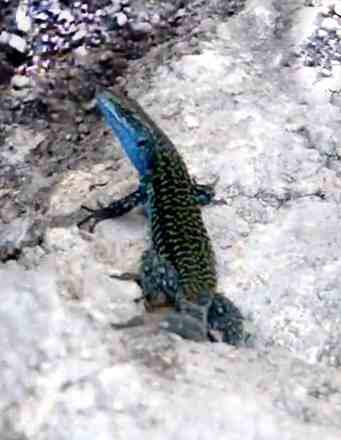
The Drago di Santo Janni or Podarcis siculus paulae is a blue-gray lizard, a subspecies of Podarcis siculus, and is endemic to the islet of Santojanni in Maratea.
It was recognized as an endemic species and then as a subspecies in 1971 in a study published in 1971 by Professor Benedetto Lanza and Giuseppe Adeiani and Massimo Romiti of the Zoology Institute of the University of Florence.
Named "paulae" in honor of Signora Paola Giorgio Lanza, this subspecies of Podarcis siculus differs from similar endemics, such as the "Podarcis siculus coerulea" which lives on the Faraglioni near Capri, by being smaller in size (maximum length of head and body of 71 mm instead of 87), the absence of scutum massetericum (a bony structure present in the head of some reptiles, particularly lizards, consisting of a bony protrusion that extends from the skull and articulates with the lower jaw, providing an attachment point for the masseter muscles, those involved in chewing), and finally for the darker dorsal ground color.