The ancient Lucania
Greater Lucania
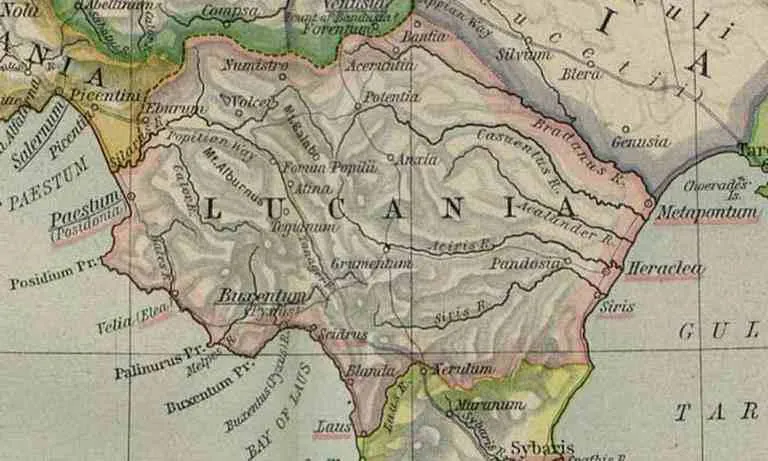
Ancient Lucania stretched from the River Sele in Campania to the River Lao in Calabria, encompassing the territories of Cilento and northern Oenotria. Today, historians regard this area as what is known as Greater Lucania.
This is thought to represent the greatest territorial extent ever governed by the Lucanians, an Oscan people who reached the banks of the Basento in the 5th century BC.
CLICK TO ENLARGE
Mario , Silla , Pirro , Annibale & c.
The Lucanians were a people with a turbulent history, marked by shifting alliances, victories and setbacks, and the conquest and loss of towns and territories. Their fate was sealed when they were overwhelmed by the Romans and definitively defeated in 82 BC, at the Battle of the Colline Gate.
That clash was the epilogue to the civil war between Marius — with whom part of the Lucanians had sided — and Sulla, who emerged victorious. The consequences were harsh: Lucanian wealth and landholdings were scattered, absorbed and gradually Romanised, ultimately eroding the very roots of their civilisation.
Over the centuries, the Lucanians fought against or allied themselves, depending on the moment, with the Greeks and the Samnites, with the King of Epirus and the Bruttians, with the Tarentines and, finally, with the Romans.
Among the most famous episodes of their epic story is Pyrrhus’ victory, achieved thanks to the use of elephants: the Romans, having never seen them before, called them “Lucanian oxen”. For different reasons, however, the exploits of Hannibal are also worth recalling: for years he ranged across Lucanian territory, plundering it, even while they were formally his allies.
That clash was the epilogue to the civil war between Marius — with whom part of the Lucanians had sided — and Sulla, who emerged victorious. The consequences were harsh: Lucanian wealth and landholdings were scattered, absorbed and gradually Romanised, ultimately eroding the very roots of their civilisation.
Over the centuries, the Lucanians fought against or allied themselves, depending on the moment, with the Greeks and the Samnites, with the King of Epirus and the Bruttians, with the Tarentines and, finally, with the Romans.
Among the most famous episodes of their epic story is Pyrrhus’ victory, achieved thanks to the use of elephants: the Romans, having never seen them before, called them “Lucanian oxen”. For different reasons, however, the exploits of Hannibal are also worth recalling: for years he ranged across Lucanian territory, plundering it, even while they were formally his allies.
La Grande Lucania [Greater Lucania]

Greater Lucania is a cultural and political movement that aims, from an administrative standpoint, to re-establish that geographical, dialectal and physical unicum known as Lucania.
In recent decades, a current of opinion has emerged — especially among the populations of the Cilento municipalities in Campania — with the goal of returning to being part of Basilicata.
This is not only in light of the geographic boundaries of ancient Lucania, which (depending on the period in question) stretched from the River Sele in the province of Salerno to the Lao plain around Scalea, but above all because of the historical and cultural continuity that these territories share.
Not to mention that there are also place names (such as Vallo della Lucania and Atena Lucana, for example) that recall those areas’ connection to Greater Lucania.
The movement seeks to involve citizens and institutions through cultural, political and scholarly initiatives, with the aim of calling referendums that would allow people to express their will and potentially lead to an administrative re-unification of the communities of Cilento and the Vallo di Diano with Basilicata.
In recent decades, a current of opinion has emerged — especially among the populations of the Cilento municipalities in Campania — with the goal of returning to being part of Basilicata.
This is not only in light of the geographic boundaries of ancient Lucania, which (depending on the period in question) stretched from the River Sele in the province of Salerno to the Lao plain around Scalea, but above all because of the historical and cultural continuity that these territories share.
Not to mention that there are also place names (such as Vallo della Lucania and Atena Lucana, for example) that recall those areas’ connection to Greater Lucania.
The movement seeks to involve citizens and institutions through cultural, political and scholarly initiatives, with the aim of calling referendums that would allow people to express their will and potentially lead to an administrative re-unification of the communities of Cilento and the Vallo di Diano with Basilicata.
www.maratea.info is kept up to date by the volunteers of
AltriTurismi ets Association
-
Support our Association MAKE A DONATION !
AltriTurismi ets Association
-
Support our Association MAKE A DONATION !